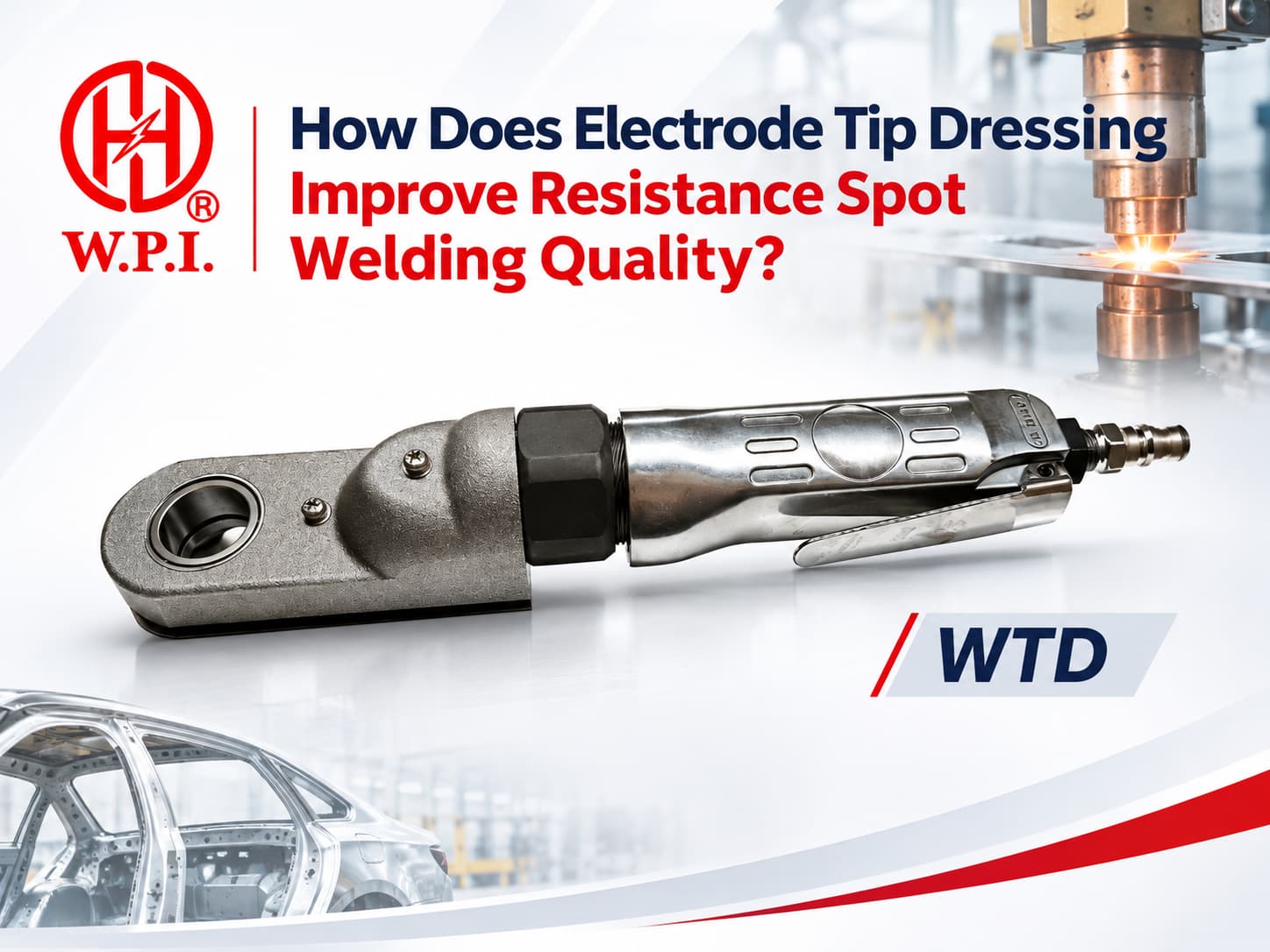
In resistance spot welding, electrode condition affects contact conditions, heat distribution, and weld consistency. As welding continues, electrode tips may mushroom, deform, or accumulate surface deposits, potentially affecting weld nugget formation and process stability.
Electrode tip dressing helps restore the required tip profile and dimensions. This article explains why electrode dressing matters, when electrodes should be dressed, and how to choose a suitable tip dresser.
Why Is Electrode Tip Dressing Important?
1. Electrode Wear Can Affect Weld Quality
As an electrode tip mushrooms or deforms, the contact area between the electrode and workpiece may change, affecting current density and heat distribution.
These changes can influence weld nugget formation and weld consistency. Surface deposits may also interfere with stable electrical contact.
2. Inconsistent Electrode Tip Geometry Can Increase Process Variation
Even when welding parameters remain unchanged, changes in electrode tip geometry may lead to variations in welding results.
Regular inspection and appropriate dressing help maintain the required tip profile. However, spatter and insufficient weld strength may also be caused by welding current, electrode force, weld time, cooling conditions, or workpiece surface conditions.
When Should Spot Welding Electrodes Be Dressed?
There is no universal dressing interval for every application. The appropriate frequency depends on:
- Workpiece material, thickness, and surface coating
- Electrode material, tip profile, and dimensions
- Welding current, weld time, and electrode force
- Daily welding volume and production cycle
- Weld quality requirements and inspection results
Electrode dressing or replacement should be evaluated when weld inspection results approach the acceptance limit, the tip becomes visibly deformed, or surface deposits begin to affect welding stability.
Establish a dressing schedule based on actual production conditions by recording welding volume, electrode condition, dressing frequency, and inspection results to determine a suitable maintenance interval.
Dressing too late may allow quality problems to accumulate, while excessive dressing removes unnecessary electrode material. A suitable maintenance program should balance weld quality, electrode service life, and production efficiency.
Electrode Dressing vs. Replacement: How to Decide?
Electrode tip dressing is suitable when surface deposits or minor deformation can be corrected while maintaining the required electrode dimensions and tip profile.
However, replacement may be necessary when the electrode becomes excessively worn, damaged, or can no longer meet the required specifications after dressing.
How Can Electrode Tip Dressing Help Maintain Consistent Weld Quality?
The purpose of electrode tip dressing is not simply to remove surface deposits, but to restore the tip geometry and dimensions required by the welding process.
Follow these practices:
- Select the correct cutter and holder: Match them to the electrode diameter, tip profile, and electrode specifications.
- Control material removal: Remove only the material needed to restore the required tip profile.
- Inspect the dressed tip: Check its profile, dimensions, and surface condition.
- Verify weld quality: Use the established inspection procedure rather than judging the result by tip appearance alone.
- Standardize the operation: Follow consistent dressing procedures to reduce operator-related variation.
A suitable tip dresser can help improve dressing consistency, but it should be used alongside correct welding parameters, electrode management, and quality inspection.
How to Choose a Suitable Electrode Tip Dresser
When selecting a tip dresser, consider electrode diameter, tip profile, cutter compatibility, operating space, maintenance requirements, and dressing frequency.
A handheld pneumatic tip dresser is suitable for routine maintenance of individual welding machines on the production line. For high-volume production, multi-spot welders, or highly automated lines, fixed or automated dressing solutions may be more appropriate.
Explore the WPI Taiwan Electrode Tip Dresser Series for available dressing equipment.
WPI Taiwan WTD Handheld Pneumatic Tip Dresser
WPI Taiwan provides electrode tip dressers for routine maintenance in resistance spot welding applications.
Before selecting the WTD, confirm that the electrode dimensions, tip profile, cutter, holder, and air supply meet your application requirements. Check the official specifications for the exact model before ordering.
Product Information: WPI Taiwan Tip Dresser
Looking for an Alternative to the Original MEIKU ETD-18F?
WPI Taiwan's WTD matches the specifications and dimensions of the original MEIKU ETD-18F model and may be considered by users with existing ETD-18F applications. Before ordering, confirm compatibility with the cutter, holder, and electrode specifications.
WPI Taiwan is an independent resistance welding equipment manufacturer. The WTD is a WPI Taiwan product and is not represented as an officially authorized replacement or successor to the MEIKU ETD-18F.
Frequently Asked Questions About Electrode Tip Dressing
How often should spot welding electrodes be dressed?
Dressing frequency depends on the material, electrode condition, welding parameters, production volume, and quality requirements. Establish a schedule based on electrode inspections and weld-quality results.
Can electrode tip dressing eliminate weld spatter?
Not necessarily. Dressing helps maintain electrode geometry, but spatter can also be caused by welding parameters, electrode force, workpiece surface conditions, and other process factors.
Does frequent dressing extend electrode life?
Appropriate dressing helps maintain the required tip profile. Excessive dressing removes unnecessary material and may shorten electrode service life.
Is a handheld pneumatic tip dresser suitable for every production line?
No. Handheld tools are suitable for individual welding machine maintenance. High-volume or multi-spot automated production may require a different dressing arrangement.
Maintain Consistent Spot Welding with WPI Taiwan
An appropriate dressing schedule, correct tooling, and regular weld-quality inspections help maintain electrode condition and reduce process variation.
WPI Taiwan has manufactured resistance welding equipment since 1975. Contact us to discuss your electrode maintenance requirements.
WPI Taiwan | Welding Process Industrial Co., Ltd.
Tel: +886-4-2407-0658
Email: welding@ms14.hinet.net
Website: www.wpitaiwan.com